Industry Insights
October 29, 2014
NNT in Pain Management: You've Been Right all Along
- National
- - 0 shares
The National Safety Council's Dr. Don Teater has penned a white paper that contains powerful data and interesting insights regarding the use of opioids for chronic non-cancer pain. And it turns out, you've been right all along...
First, a pause for acronym education. Just when you were getting a handle on MEDs... let me introduce you to NNT (number needed to treat). This is a common measure in clinical studies that answers the question: How many people need to be treated with a given intervention for one person to receive a defined effect? A lower NNT means the intervention is more effective (1 is the ideal... if you treat one person and that person achieves the defined effect, an NNT = 1 means you've got a really effective treatment). A higher NNT means the intervention is less effective.
For instance, how many people need to be treated with Oxycodone 15 mg for one person to receive 50% pain relief? Turns out the answer to that question is 4.6.
How many people need to be treated with a combination of ibuprofen 200 mg acetaminophen 500 mg for one person to receive 50% pain relief? Drum roll, please ... 1.6.
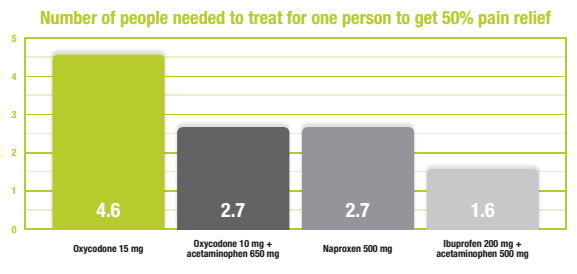
He also shares similar data from a couple of other studies.
Why do providers turn to opioids so frequently in light of data such as this? Why does this inherent belief exist that suggests opioids are more powerful analgesics? Dr. Teater cites several reasons, but the two that caught my eye:
Opioids exhibit powerful psychotherapeutic effects not found with ibuprofen and acetaminophen. If a patient's back hurts, Tylenol and Advil will work fine. If a patient's back hurts and they're depressed, opioids are more likely to be perceived by the patient as effective. This sounds obvious to most of us, but separating the clinical effects of opioids into "analgesic" v. "psychotherapeutic" has significant implications for the use of these medications.
The pharma companies have spent several billion dollars during two decades getting doctors comfortable with opioids. Where there's money to be made... there's usually a rep standing by to help a doctor make a decision that may not be fully informed.
Bottom line: You've been right all along. For most patients, ibuprofen and acetaminophen are safer and more effective than opioids.
Michael Gavin is president of Prium, a national managed care provider for the workers' compensation industry. This column was reprinted with his permission from the firm's Evidence Based blog.
Advertisements
Columns
- Cohen: Returning People to Work Starts With Returning Them to Life 05/20/26
- Zachry: Managing Grief in Workers' Compensation 05/13/26
- CAAA: DWC Audit Raises Concerns Over Unpaid Benefits, Systemic Violations 05/12/26
- Montgomery: N.Y. Is Right to Celebrate. What Can Calif. Learn? 05/11/26
- Paduda: What's Up in Work Comp? 05/08/26
- Lalancette: Recent Clarifications of the Going-and-Coming Rule 05/06/26
- Goldstein: Costly 3% Diclofenac Raises Questions About Who Benefits 05/01/26
- Zachry: Better Care, Better Recovery, Better Outcomes 04/29/26
- Curtius: Medicare Set-Asides in Workers' Compensation Settlements 04/27/26
- Barthel: Challenging Dishonesty in the Work Comp System 04/20/26
- Paduda: Why Work Comp Won't Change 04/17/26
- Kamin: DWC Posts Helpful QME Checklists 04/15/26
- Sykes: What Workers' Comp Adjusters Are Building to Fill the Coordination Gap 04/13/26
- Goldstein: Sweeping PBM Drug Pricing Reforms Don't Apply to Workers' Compensation 04/10/26
- Holland: Universal Authorization Is a Much-Needed Fix for Workers' Compensation 04/09/26
- CAAA: When Enforcement Fails at Cal/OSHA 04/08/26
- Montgomery: Hochul Calls for 'Universal' Provider Authorization 04/06/26
- Ashkenazi: Guardian Ad Litem: Minor Dependents and More 04/03/26
- CAAA: How Allostatic Load Affects a Worker's Injuries and What Impairment May Result 04/01/26
- Yi: How to Create Multiple CTs 03/30/26
Now Trending
- Workers' Compensation News
-
Calif. Bill Would
Expand Limitations on Athlete…
Posted on May 20, 2026
-
Calif. DWC Issues
Statement on Subbing Narrative
Report for RFA…
Posted on May 19, 2026Stephanie Smith says: “The regs do NOT require a response to a narrative report if…”
-
Calif. SIBTF Bill
Keeps Moving; Treatment Leave Bill…
Posted on May 18, 2026
-
Calif. IMR
Applications, UR Uphold Rate Both
Increase in…
Posted on May 21, 2026
-
Fla. Court Allows
Estate to Sue Team Doctor Over
Player's…
Posted on May 19, 2026
-
Calif.
Commissioner Approves WCIRB
Regulatory…
Posted on May 18, 2026
-
W.Va. Split
Supreme Court Upholds Denial of
Diabetic Worker's Carpal Tunnel…
Posted on May 15, 2026
-
N.Y. Worker Gets
Partial Summary Judgment on Labor
Law Claim for Grinder…
Posted on May 15, 2026
-
Colo. Lawmakers
Pass Firefighter Presumption,
Electronic Service…
Posted on May 14, 2026
-
N.Y. Carrier Has
Duty to Defend Insured From Injured
Workers'…
Posted on May 20, 2026
Jobs
- WORKERS COMPENSATION DEFENSE ATTORNEY
- DEPUTY CITY ATTORNEY I-II (W/C)
- Workers' Compensation Litigation Associate
- Director, Medical Payment Operations Workers' Compensation
- Workers’ Compensation Attorney (Defense)
- Workers’ Compensation Defense Attorney (Entry-Level or Experienced)
- Workers’ Compensation Defense Attorney Workers' Compensation Jobs
Press Releases
Upcoming Events
May 21, 2026
AWCP’s Spring into Action: Ca
Stay up to date on latest legal developments with S. Isaac Escobedo, Esq. and Steven J. Rosendin, …
Jun 12, 2026
AWCP’s 27th Annual Golf Tourna
Get ready to “Be the Ball!” at AWCP’s 27th Annual Caddyshack Classic. Spend the day at Lincoln Hil …
Jun 23, 2026
FEATURED WEBINAR: Medicare Cha
Rafael Gonzalez, Esq. and John V. Cattie, Jr., will provide practical, real-world guidance to help …
Social Media Links
c/o Business Insurance Holdings, Inc.
Greenwich, CT 06836





No Comments
Log in to post a comment